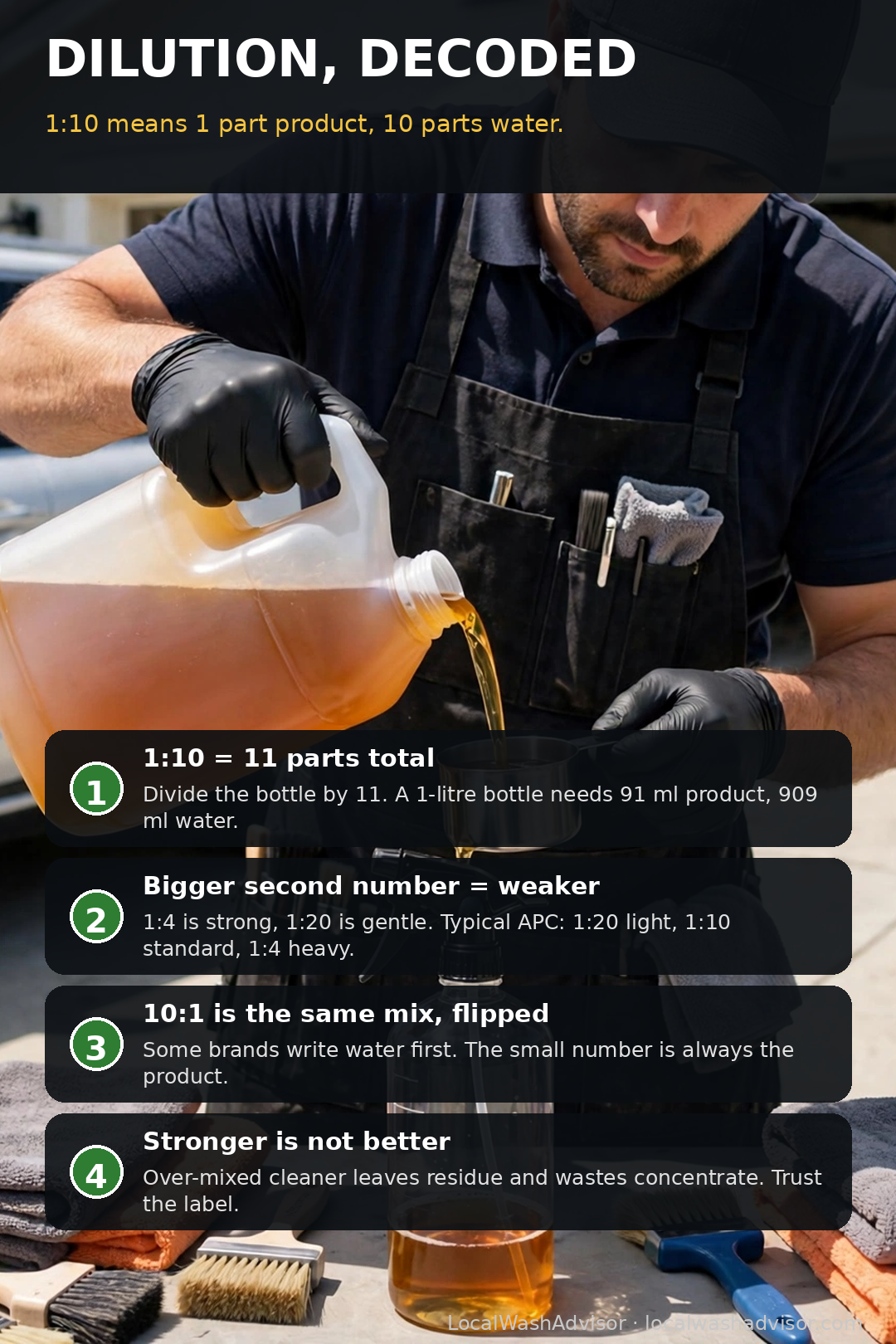
Dilution Ratios, Decoded
Dilution Ratios, Decoded
That little "1:10" on the back of the bottle is quietly the most expensive sentence in your van. Get it right and a gallon of concentrate becomes months of working solution. Get it wrong and you're either washing with flavoured water or stripping trim with a mix far hotter than the label ever intended. The good news: the math takes ten seconds once someone actually explains it.
A dilution ratio is just a recipe written in parts. When a label says 1:10, it means 1 part product to 10 parts water. The trap is the total: 1 + 10 = 11 parts, not 10. So for a 1-litre spray bottle at 1:10, divide 1000 ml by 11 — that's 91 ml of product, and the remaining 909 ml is water. The same rule scales to anything: divide your container by the total parts, and that one number is your product dose. A 32 oz bottle at 1:10 works out to about 2.9 oz of product, the rest water.
Watch out for the flipped version. Some brands write the ratio water-first, as 10:1 — ten parts water to one part product. It's the same mix as 1:10, just written backwards. The rule that never fails: the small number is always the product. If you ever see a ratio and can't tell which side is which, that rule settles it.
Strength follows the second number. The bigger it is, the weaker the mix: 1:4 is strong, 1:20 is gentle. All-purpose cleaners typically run 1:20 for light interior work, 1:10 for standard cleaning, and 1:4 for heavy grime — but those are typical ranges, not gospel. Every brand formulates differently, so the label on your bottle outranks any chart, including this post. Snow foams are the worst offenders for label roulette: one brand's 1:10 is another's 1:20, and copying a buddy's ratio onto a different product is how foam dies on contact.
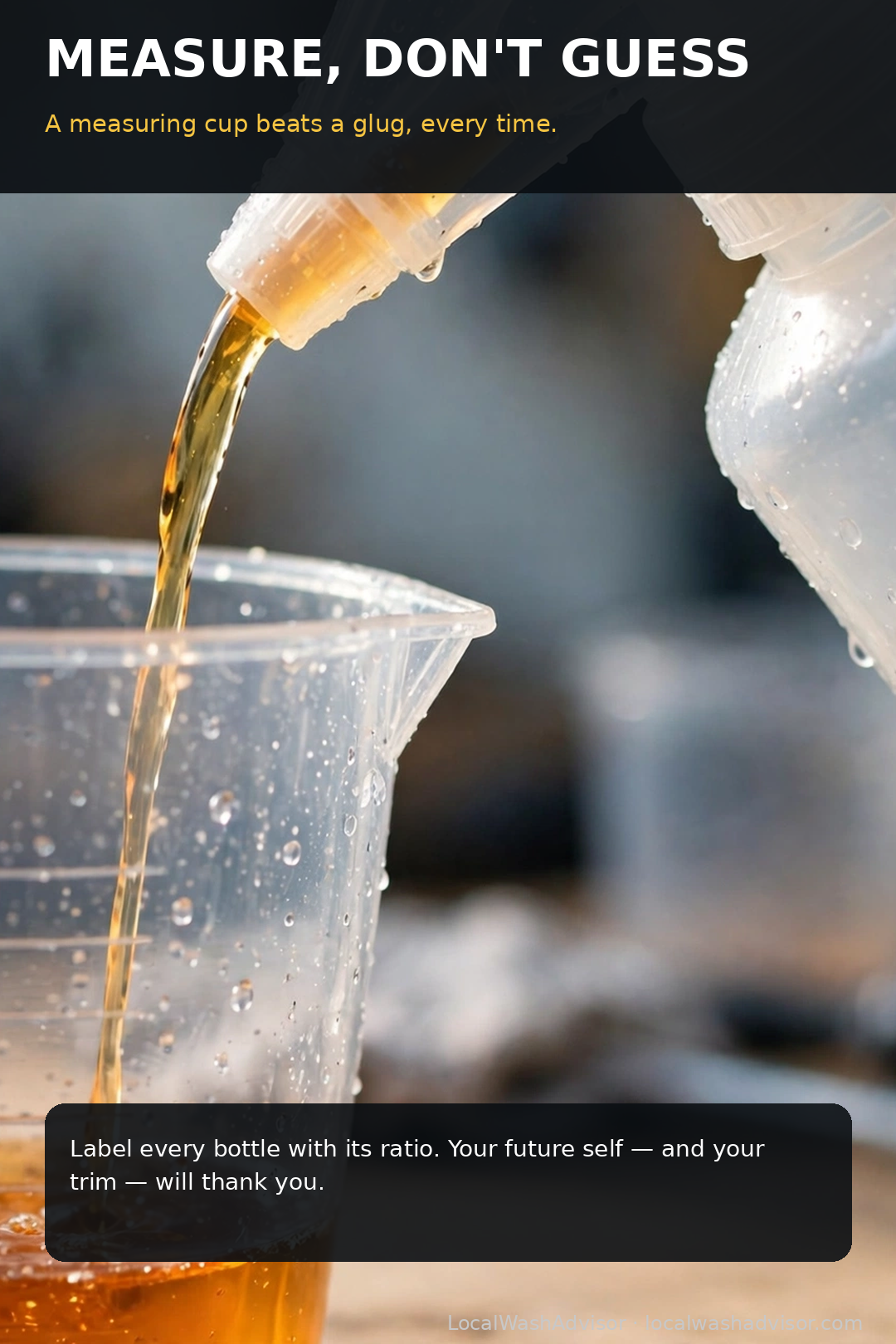
The three mistakes that cost real money are all avoidable. Eyeballing a "glug" instead of measuring — a glug is anywhere from 30 to 90 ml depending on the bottle, which means your mix swings wildly from job to job. Copying a bucket ratio into a spray bottle without rescaling — the ratio is the same, but the dose isn't, and a bucket dose in a trigger bottle is a chemical burn waiting for a dashboard. And the big one: assuming stronger cleans better. Over-mixed cleaner doesn't lift more dirt, it leaves residue that streaks glass, dulls trim, and forces a re-wash. The label strength is where the chemists tuned the surfactants to work — stronger just wastes concentrate.
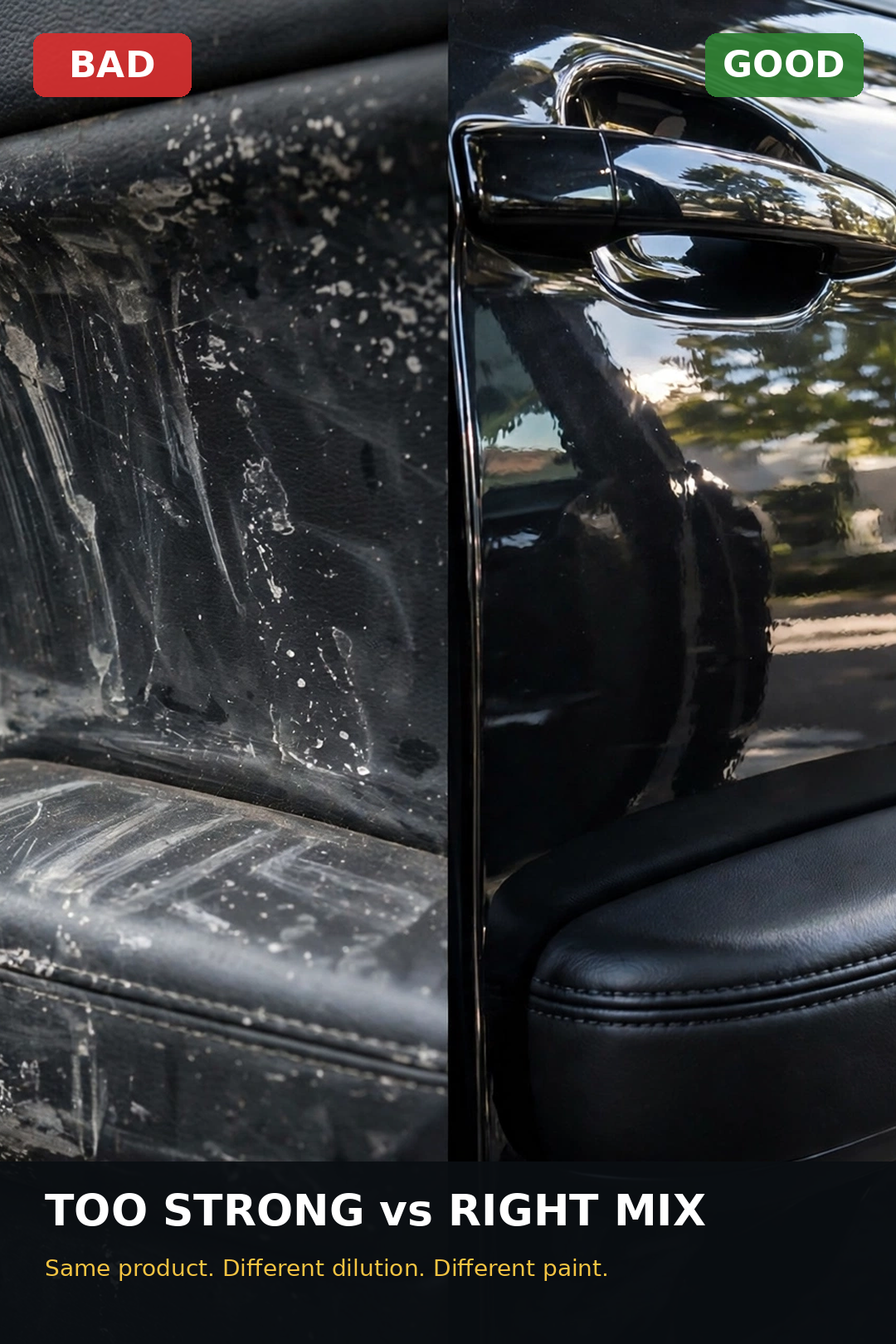
The takeaway: measure once, write the ratio on the bottle with a marker, and mix the same way every time. A measuring cup costs nothing, a labelled bottle ends the guessing, and consistent dilution is the cheapest upgrade in detailing — your results get repeatable, your concentrate lasts longer, and your customers' trim stays intact.
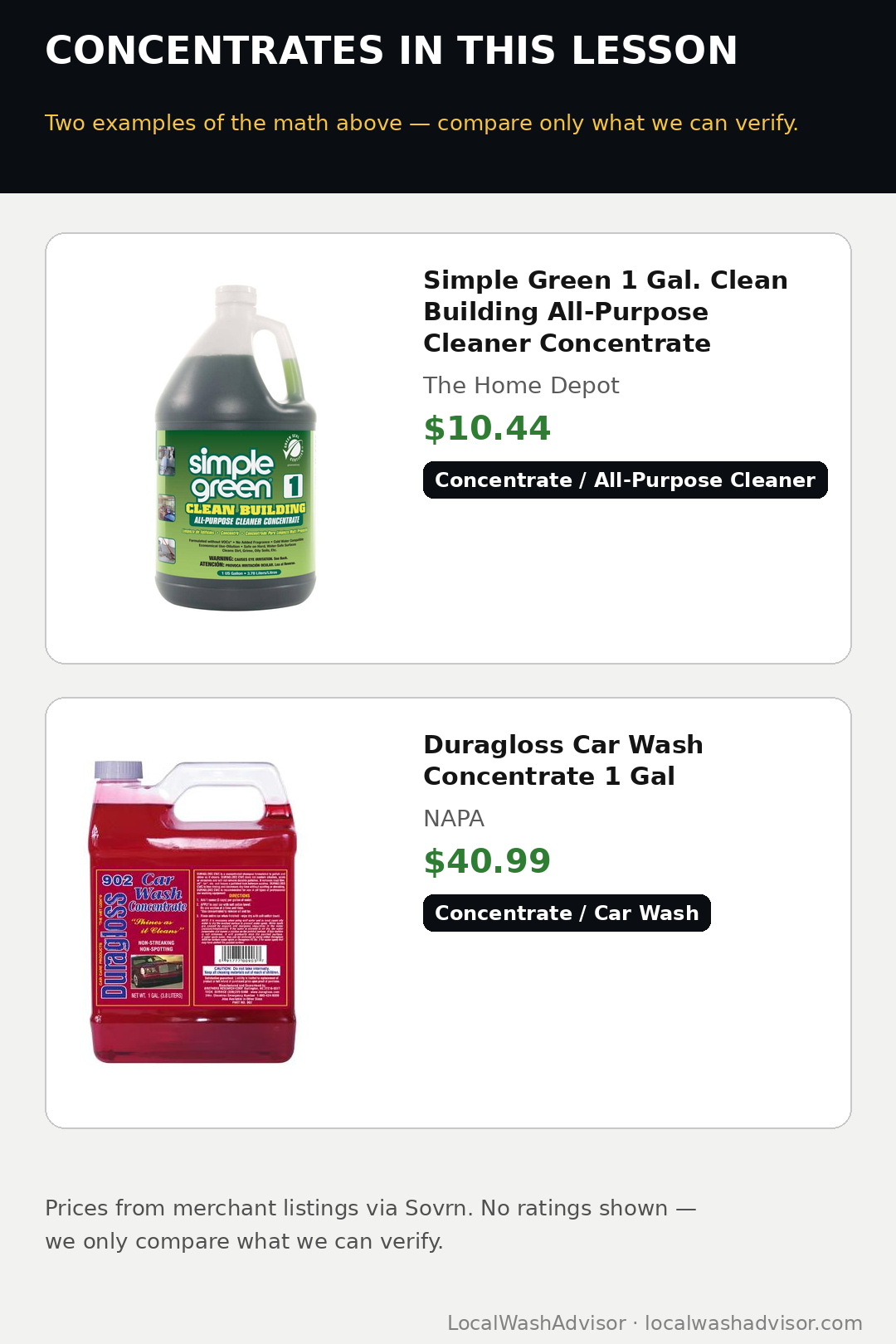
Products mentioned: concentrates like these are typical examples of the lesson — a gallon of concentrate becomes many gallons of working solution once diluted. Simple Green 1 Gal. Clean Building All-Purpose Cleaner Concentrate — The Home Depot — $10.44. Duragloss Car Wash Concentrate 1 Gal — NAPA — $40.99. Links above are affiliate links — we may earn a commission if you buy through them.
What's the ratio you reach for most — 1:4, 1:10, or 1:20?
Products from this lesson
Simple Green All-Purpose Cleaner Concentrate 1 Gal — The Home Depot, $10.44 Duragloss Car Wash Concentrate 1 Gal — NAPA, $40.99
Find Local Car Washes
Discover trusted car washes in your area and save with exclusive coupons on LocalWashAdvisor.
Browse Car WashesThis article was created by Shine, our AI Car Care Advisor, to provide helpful information about car care and local services.
Get prices from car washes and mobile washers
Tell us what you need once. Up to 3 nearby businesses can each send you one exact price and time. Nothing is booked until you choose one and confirm.
Related Articles
Detailer Advisor: You Booked the Customer — You Didn't Book the Parking Lot
A mobile detailer was confronted twice over permission to work in a customer's rented office lot. Treat permission as part of the booking — get it in writing.
DECODE #4: Meguiar's Smooth Surface Clay Kit
Meguiar's Smooth Surface Clay Kit decoded: what clay pulls out of paint, why lubricant is never optional, and the per-gram cost of the three-bar kit.
DECODE #8: Meguiar's Microfiber Wash Mitt (8" x 10")
Meguiar's Microfiber Wash Mitt decoded: why a plush mitt beats a flat sponge, how its loops trap grit away from paint, and the cost per wash over a year.