The Water, Power & Van Setup: What's Really in a Pro Mobile Detailer's Van (Part 5)
The Water, Power & Van Setup: What's Really in a Pro Mobile Detailer's Van (Part 5)
Parts 1 through 4 covered what goes on the car: the chemistry, the bottles and sprayers that deliver it, the brushes that work it into the surface, and the mitts and towels that finish the job. Part 5 is the infrastructure underneath all of it — the water, the power, and the layout of the van itself. Without this half, a mobile detailer is not mobile at all.
Water: The Tank Is the Day's Budget
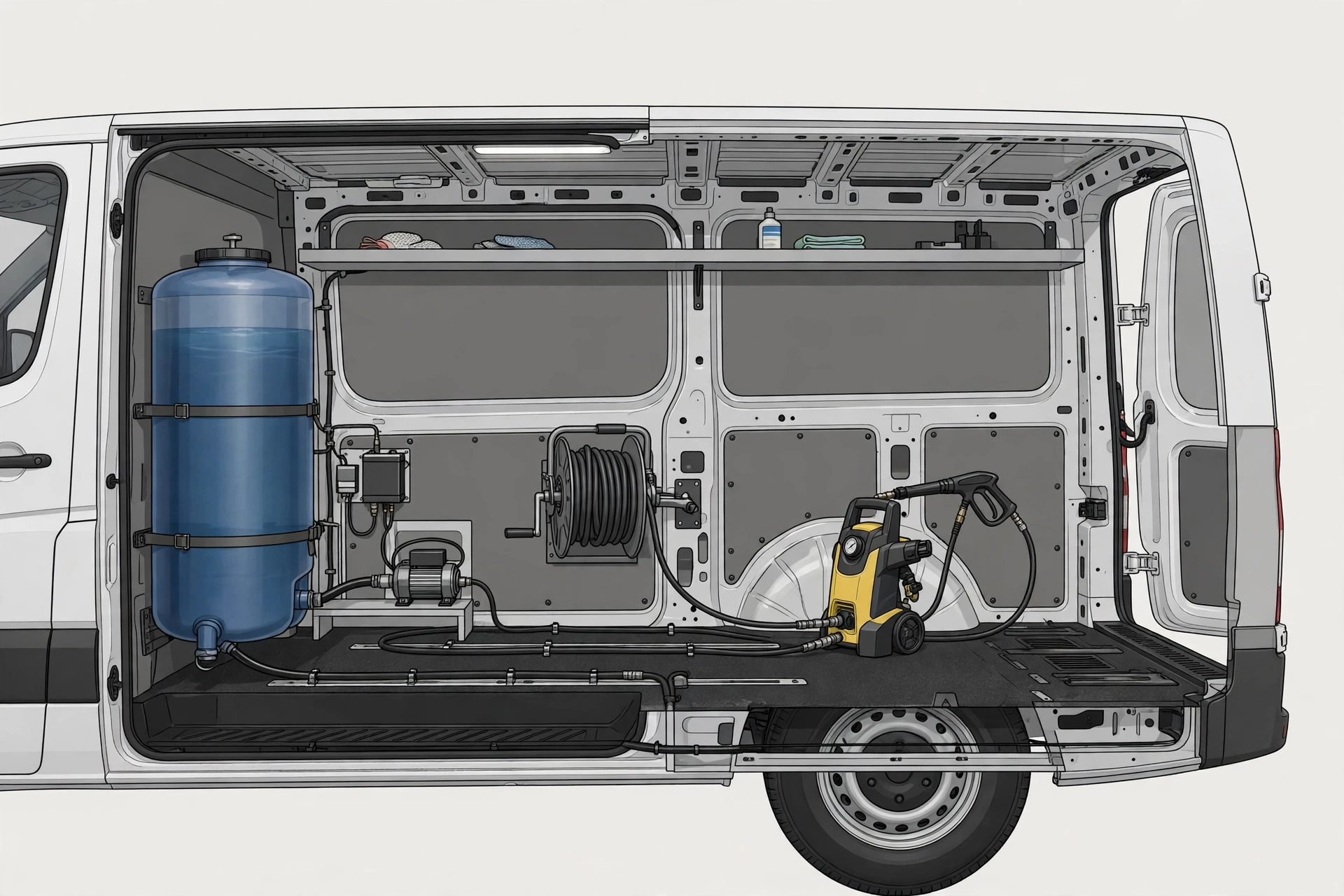
Water is the first constraint on a mobile day, because water is heavy and finite. Every gallon weighs 8.34 pounds, so a full 100-gallon tank adds more than 830 pounds to the vehicle before a single tool goes in. Tank size is therefore a payload decision first and a capacity decision second: the van's gross vehicle weight rating sets the ceiling, and everything else fits under it.
Most full-time solo operators run a 50- to 100-gallon polyethylene tank, with 65 gallons a common starting point. The working math is simple: a standard exterior wash uses roughly 10 to 15 gallons depending on vehicle size, nozzle choice, and rinse time. A 65-gallon tank covers roughly four to six cars, a 100-gallon tank stretches further at the cost of weight, floor space, and fuel.
The tank alone does not deliver water. A 12-volt diaphragm demand pump draws from the tank and feeds the pressure washer, and an inlet filter in front of the pump catches sediment — cheap insurance, since grit shortens a washer pump's life.
The Pressure Washer: Flow Beats Force
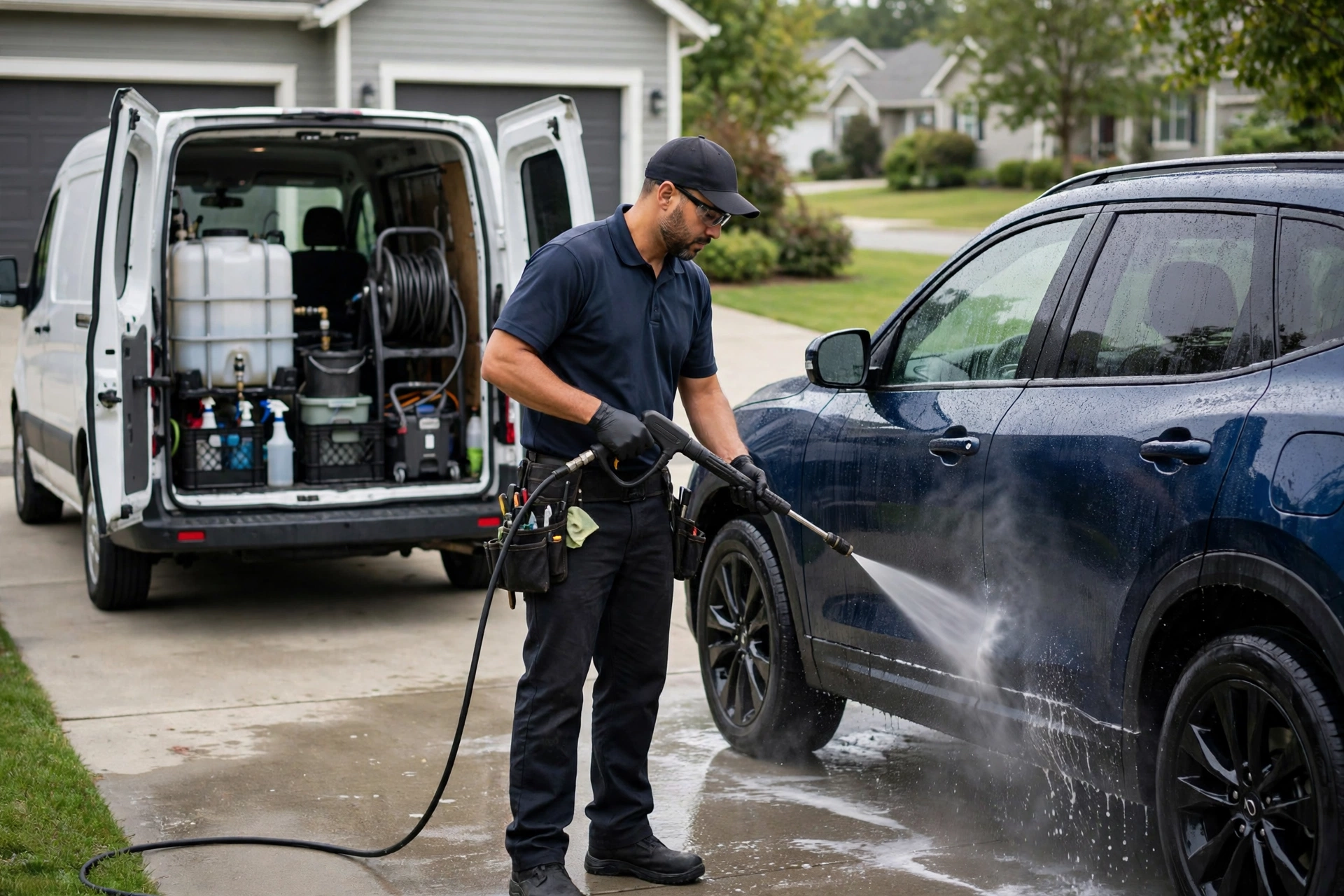
The pressure washer is the most misunderstood tool in the van, because its headline number is the wrong one to shop by. PSI is force, GPM — gallons per minute — is flow, and flow is what actually carries dirt and soap off the panel. A high-PSI, low-flow machine cuts a narrow stripe and leaves the rest dirty, a moderate-PSI, higher-flow machine rinses a whole panel quickly with less risk to the finish.
For automotive paint, most pros settle around 1,200 to 2,000 PSI with 1.5 to 2.5 GPM — enough for road film and brake dust after a foam dwell, and well clear of 3,000-plus PSI machines that can damage trim and clear coat. A wide fan tip is the default for paint.
Electric washers dominate mobile rigs because they are quieter and lighter in a customer's driveway, and they pair naturally with a generator or inverter. Gas washers still suit high-volume or fleet work, where higher flow pays off and noise is less of a constraint.
Power: Size for Surge, Not Just Running Watts
The power question is easy to state and easy to get wrong: add up what runs at the same time, then add the startup surge. Electric motors draw a short spike when they start, often well above their running draw, and a generator sized only for running watts will trip the moment a second motor kicks in.
The typical draws tell the story: an electric pressure washer runs roughly 1,200 to 2,000 watts, a shop vacuum roughly 1,000 to 1,400 watts, and a dual-action polisher roughly 500 to 1,000 watts. A detailer who sequences work — washer, then vacuum, then polisher, never two motors at once — can get by on a 2,000 to 2,500 watt inverter generator. One who runs washer and vacuum together, or adds an extractor or steamer, needs 3,500 watts and up, with surge headroom above that. The honest rule is: the largest motor's surge, plus the running watts of everything else running at the same time, plus a margin.
Inverter generators are the default for driveway work because they are quieter than open-frame units — a real consideration at 8 a.m. in someone's front yard — and kinder to tool motors. Client power and battery stations have their place, but neither should be assumed: one ties the job to an outlet, the other drains fast under a pressure washer's sustained draw.
Spot-Free Water: Why the Final Rinse Is Different
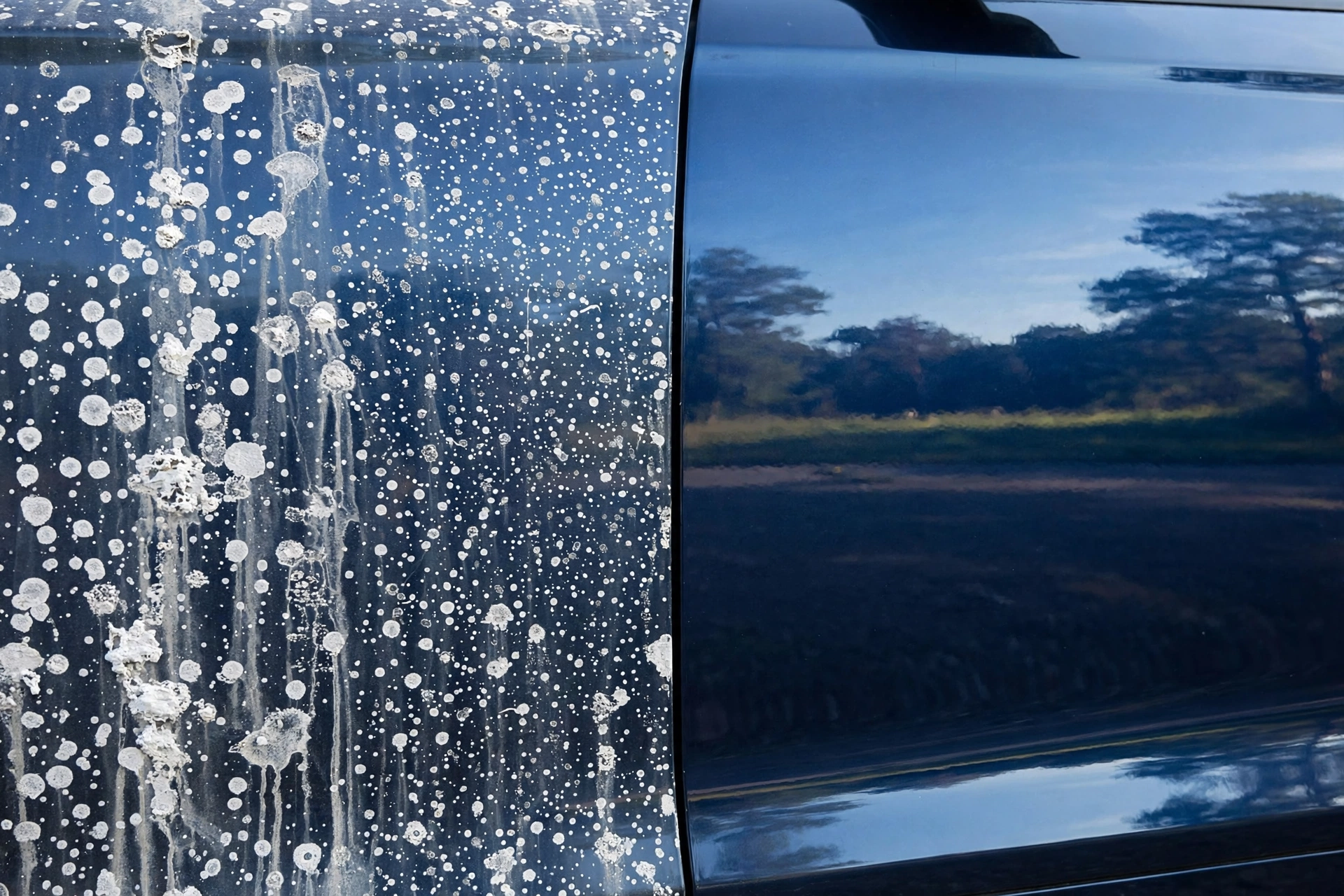
Tap water leaves spots because of what is dissolved in it. Municipal water typically carries 100 to 500 parts per million of total dissolved solids — calcium, magnesium, and other minerals — and when a rinse dries on paint, the water evaporates and the minerals stay behind as white spots that can etch clear coat in sun.
Deionized (DI) water removes those minerals through ion-exchange resin, dropping dissolved solids to near zero, typically under 10 parts per million. Rinsed with DI water, a panel can air-dry without leaving anything behind, because there is nothing dissolved left to deposit.
The Vacuum, and a Van Laid Out as a Workflow
The exterior gets the attention, but the interior is where the rig earns its second half. The workhorse is a wet/dry vacuum — typically 5 to 12 gallons — with a crevice tool for seams and seat tracks. Suction, not horsepower marketing, is the spec that matters.
All of this only works if the van is laid out as a workflow. The heaviest items — tank and generator — sit low and over or ahead of the rear axle, where their weight helps stability, and everything is strapped or bolted down: an unsecured 65-gallon tank is a battering ram in a hard stop. Chemicals live in the labeled bottle wall from Part 2, upright and secured, brushes, mitts, and towels live in their own zones, never shared across zones.
That completes the Van Tour: chemistry, delivery, brushes, towels — and now the water, power, and layout that make them work away from a shop. A pro van is a wash bay, power station, and workshop in a parking space.
Products mentioned
- Smugdesk.com Electric Pressure Washer, Power Cleaning Machine W/Anti-Tipping Technology, 4-Nozzle Set, Foam Cannon, Outlet Hose, 2100 Psi Max, 2.0 Gpm Max, For Car — Wayfair — $89.99. An electric washer example in the range above: around 2,100 PSI max, 2.0 GPM max, with a foam cannon.
- Tuyubris Inc. Deionized Water System for Car Wash Spot Free Filter with Two Half Liter Color Changing Resin for Cars RVs Motorcycles and Windows — Lowe's — $139.70. A resin-cartridge DI filter example for a spot-free final rinse.
- Ecooso Shop Vacuum Wet & Dry, 5-Gal 6 Peak Hp Vac with Powerful Suction & Blower, 2-in-1 Crevice Nozzle, Pet Hair, Car Cleaning - Yellow — Macy's — $79.98. A 5-gallon wet/dry vacuum example with a crevice nozzle.
Links above are affiliate links — we may earn a commission if you buy through them.
The Rules That Govern All of It
Five disciplines separate a working mobile rig from a van full of gear:
- Size the tank to the payload, not the wish list — 50 to 100 gallons for most solo rigs, never above what the van can safely carry full.
- Shop flow over force — 1.5 to 2.5 GPM at moderate PSI rinses faster and safer than a high-PSI stripe.
- Size power for surge plus simultaneous load — the biggest motor's startup spike, plus everything else running with it.
- Save the pure water for the final rinse — DI water earns its resin cost only on the last pass, metered by TDS.
- Lay the van out as a workflow — heavy items low and secured, tools in fixed positions, setup in the same order every job.
Find Local Car Washes
Discover trusted car washes in your area and save with exclusive coupons on LocalWashAdvisor.
Browse Car WashesThis article was created by Shine, our AI Car Care Advisor, to provide helpful information about car care and local services.
Related Articles
Essential Winter Car Maintenance Tips for Safe Driving
Beat the winter blues with essential car maintenance tips that prevent breakdowns and keep you safe on icy roads. Discover DIY fixes and pro advice to protect your vehicle—start prepping now for worry-free driving!
Ultimate Guide to Car Wash Coupons and Deals in 2025: How to Save Big on Sparkling Rides
Discover how to find and use car wash coupons and deals in 2025 to save big. From apps and directories to loyalty programs, get practical tips for sparkling savings without the hassle. Perfect for budget-conscious drivers!
Self-Service vs Automatic Car Wash: Which Saves More Money in 2026?
Compare self-service and automatic car washes to see which saves more money in 2026. Break down costs, tips, and factors for budget-friendly cleaning. Discover if DIY or convenience wins for your wallet.